
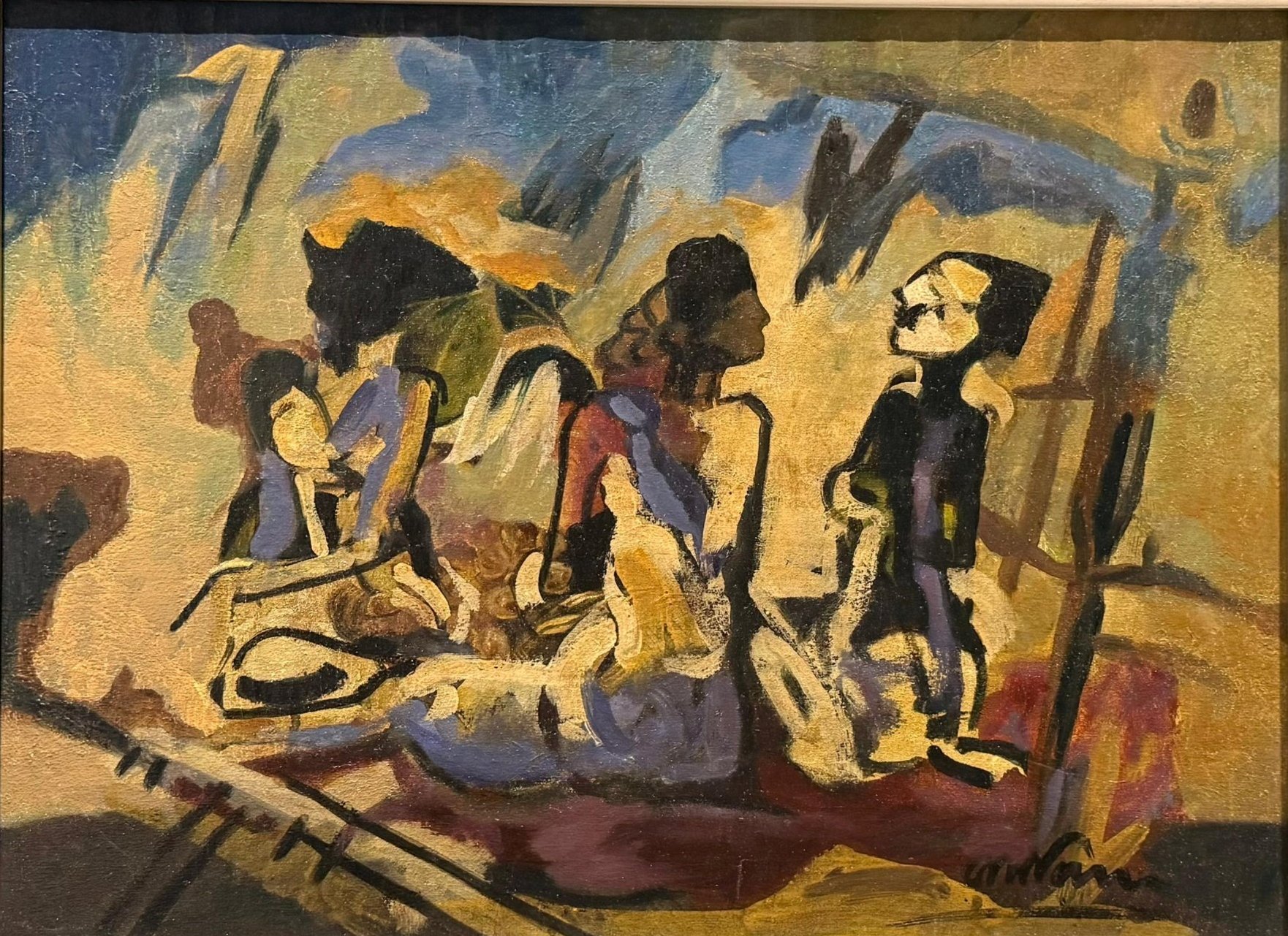
Most paintings ask you to stand still in front of them. The murals of Santiniketan were made for people walking past on their way to a class, a meal or a song.
When Nandalal Bose came back from copying the cave paintings at Ajanta in 1909, he carried one idea home with him: a painting on a wall is not owned by anyone. It belongs to everyone who passes it. At Kala Bhavana he made that idea a lesson. Teachers and students painted the walls, ceilings and verandas of the campus together, often without signing their names.
If you ever stand in front of one of these walls, here are four ways to look.
Walk, do not stand
Many of these murals are long and low, running the length of a corridor or a hall. They are meant to be read the way you read a scroll, a step at a time. Benode Behari Mukherjee's great mural at Hindi Bhavana, painted in true fresco in 1946 and 1947, runs for more than twenty metres around the hall, filled with the saints of medieval India and the worlds around them. There is no single best spot to see it from. Let it unfold as you move.
There is no single best spot to stand. Let the wall unfold as you move.
Look for ordinary life
Nandalal sent his students out to draw what was in front of them: Santhal women carrying water, bullock carts, trees in each season, craftsmen at work. Those sketchbooks came back onto the walls. Even when a mural tells an old story, look at the edges. You will usually find the people and animals of Birbhum going about their day.
Follow the line
The Bengal School learned from Ajanta, from Mughal miniatures and from East Asian brush painting, and all of them trust the line. Look at how a single stroke holds the curve of a shoulder or the bend of a branch, and how much is left unpainted around it. The quiet spaces are part of the picture.
Read the wall itself
These murals were painted in tempera and in fresco, straight onto plaster, and they have lived through almost a century of Bengal summers and monsoons. Some have faded, some have been carefully restored, and a few have been lost. Next to them stands Kalo Bari, the Black House, a mud building finished in coal tar whose outer walls Ramkinkar Baij and his students carved in relief. The surface, cracks and all, is part of the story of how this art was meant to live: in the open, with the people it was made for.
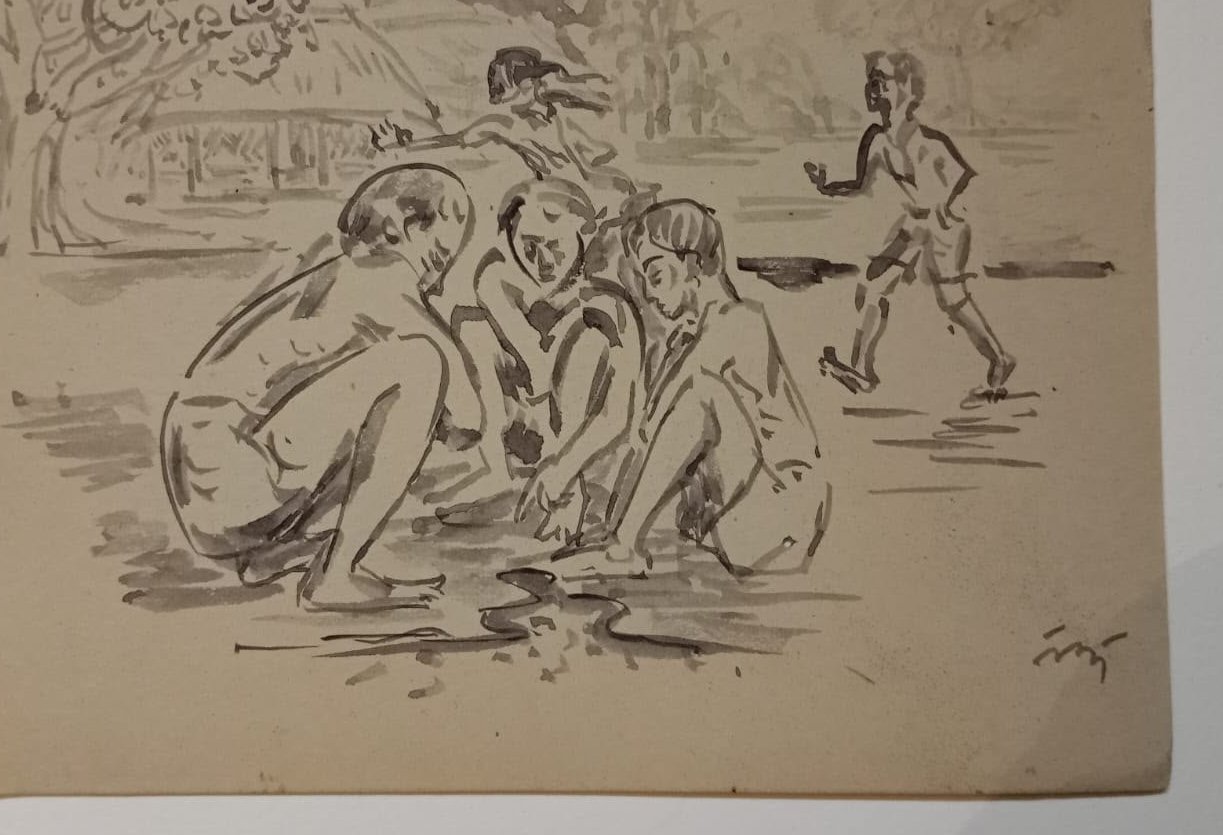
Photograph: [credit and permission]
In 2023 UNESCO named Santiniketan a World Heritage Site, and the murals are a large part of why. If you visit, give them time. And if you cannot go to Birbhum just yet, come and see the work of the same hands at the house in South Delhi.